Climate Resilience ● Transdisciplinary Research ● Product Design
We must remember that capital makes no willing concession without struggle.
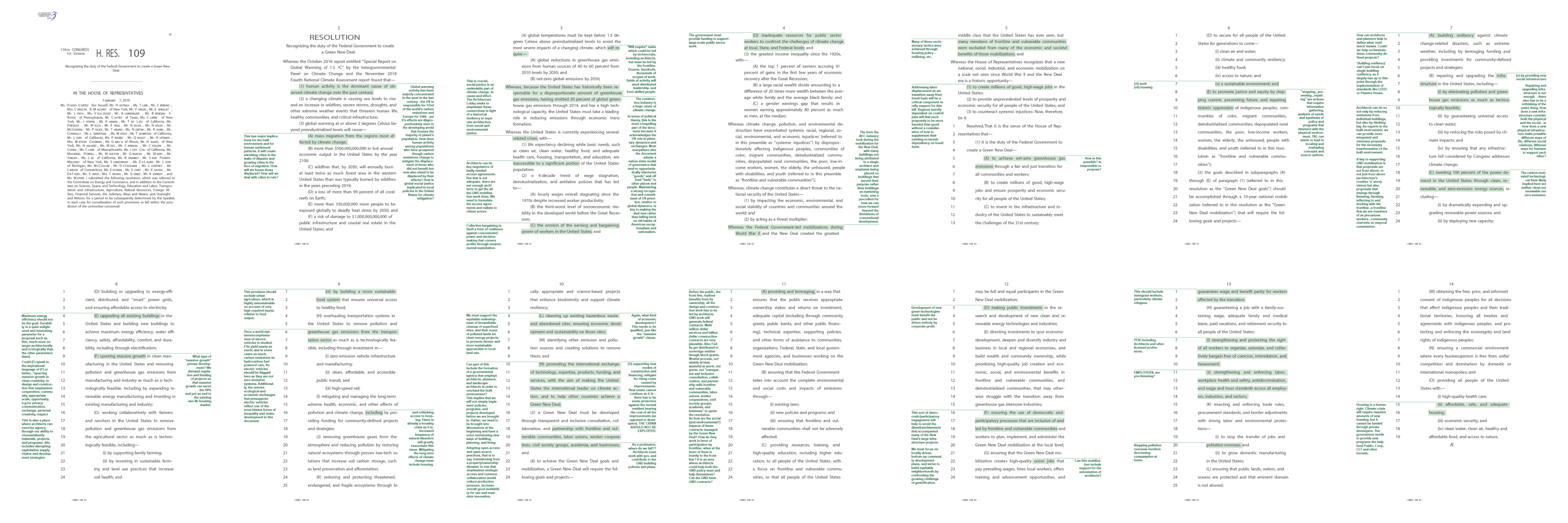
The Architecture Lobby supports a Green New Deal, as proposed in House Resolution 109. We believe the redistribution of political and economic power outlined by the resolution is mandatory to effectively respond to the climate crisis. Like the crisis itself, the timetable for transformation is immediate and relentless. The Architecture Lobby is committed to the resolution’s call for a just transition. We call on architects, designers, and allied disciplines to join in the work of creating a more sustainable and equitable future for all.
In order to tackle decarbonization efforts more effectively, the way we work and the way the profession is structured must change. It is our responsibility to steer architectural practice toward projects and programs that promote democracy and equity in society. Architects must reject the current model of practice as a service profession responding primarily to private capital. We cannot create visions for a more just, equitable, and sustainable world if the cultures of our own studios and academies do not follow those principles.
Architects must:
Adaptation in the wake of the climate crisis calls for new ways of relating to one another and to the built environment. The need for a new social infrastructure should guide changes in physical infrastructure. Architects must advocate for policies that reimagine resiliency at all scales, rather than incrementally repairing and replacing existing systems.
Architects must:
Design futures responding to the climate crisis are often framed through technology and building performance. Technical innovation, including the development of new materials, efficient building systems, and clean energy infrastructure, is a necessary component of climate mitigation. However, architects cannot rely exclusively on technological solutions. We must reshape our understanding of technology and innovation as design tools, acknowledging the complex power structures inherent in their development and application.
Architects must:
The transition from conventional forms of designing, constructing, and financing the built environment will change society in profound ways. We must consider the inevitable loss of jobs, creation of new jobs, and the need to establish equitable, stable working conditions while enabling the decarbonization of the economy and adaptation to a changed climate.
Architects must:

Climate change is a crisis of unevenly experienced and systemic injustices that asks hard questions of scholars, practitioners, and community members alike. The Green New Deal—most famously as drafted in US H. Res. 109 and S. Res. 59, but echoed by elected officials and activists around the world—addresses these questions head-on, linking equity, the environment, and the economy to the transformations necessitated by the climate crisis.
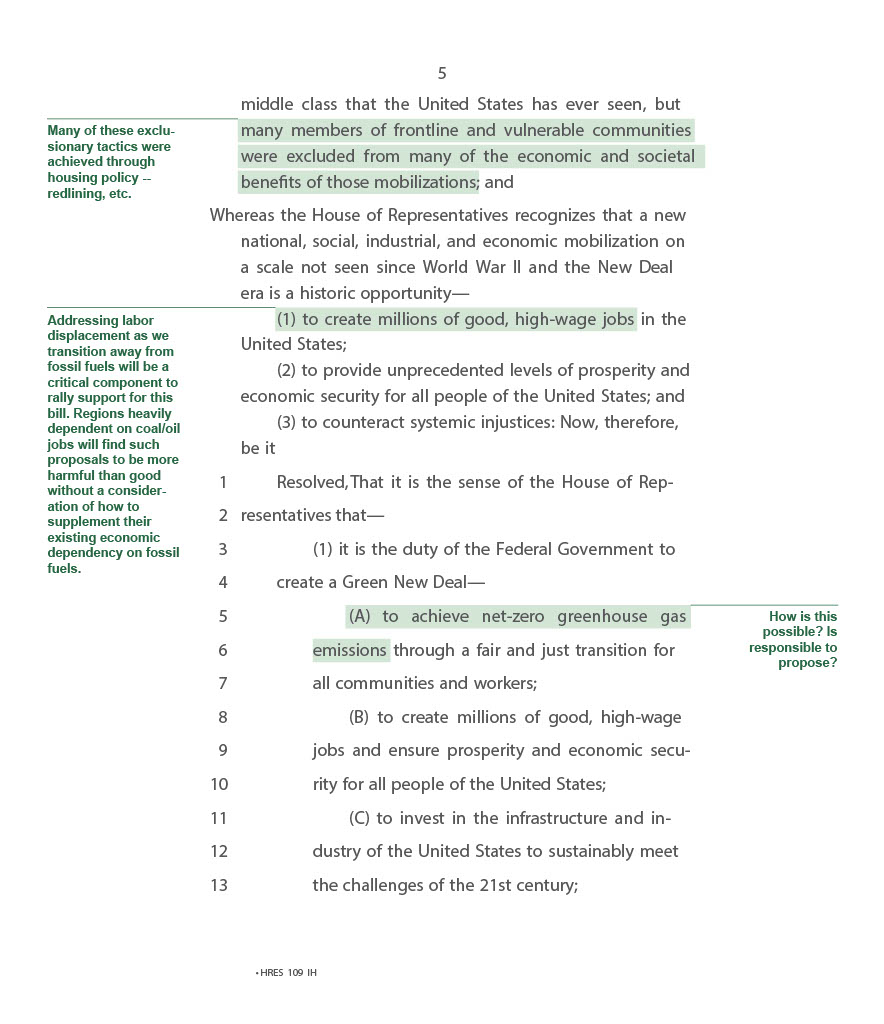
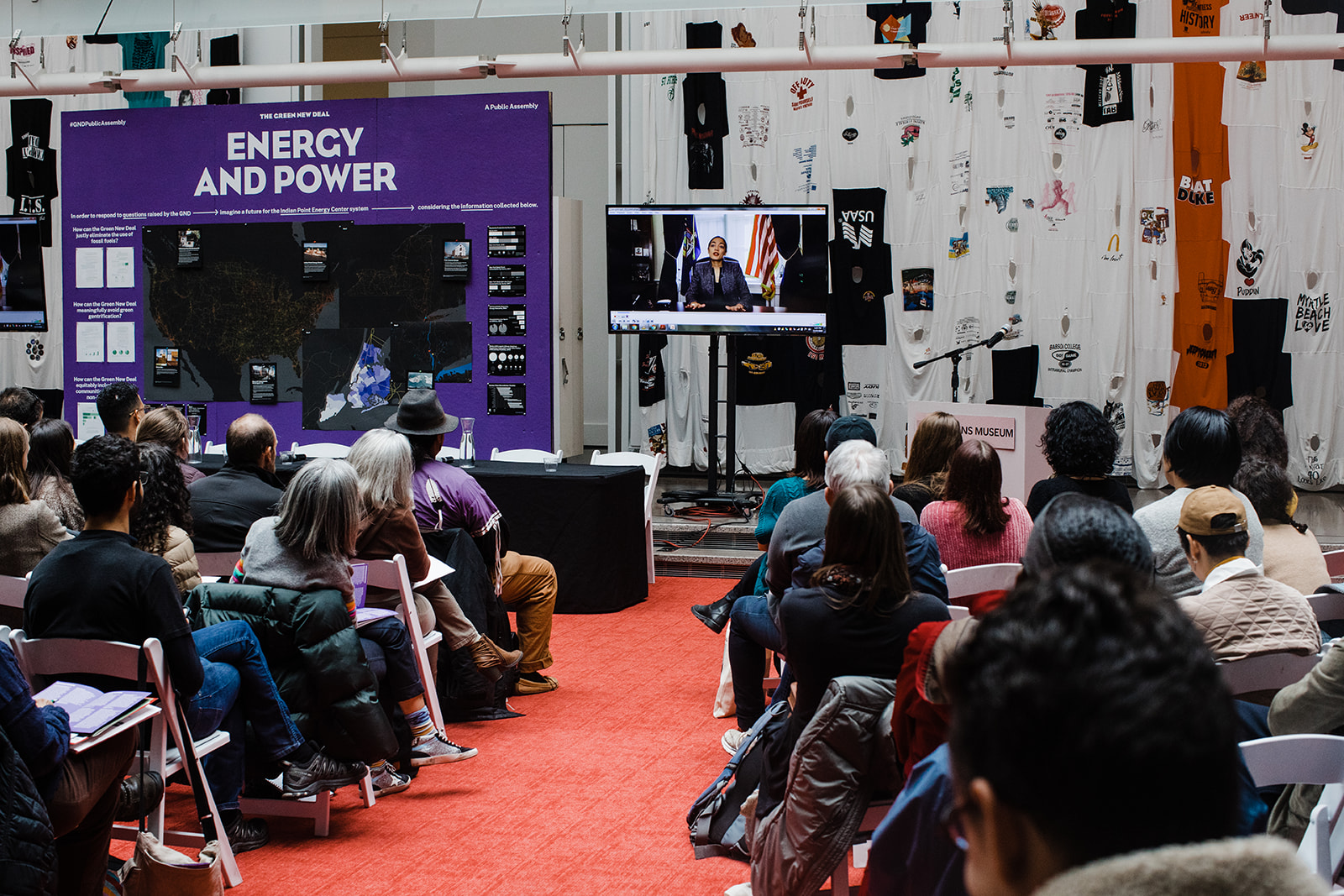
“The Green New Deal: A Public Assembly” will focus on modeling democratic debates that seriously consider the ambitions and challenges of the GND by thinking systemically and across scales. The public event included morning workshops and an afternoon series of discussions to encourage exchange among invited guests representing a range of disciplines as well as the general public. Spanish interpretation services was provided for the afternoon assembly, beginning at 1:00pm.
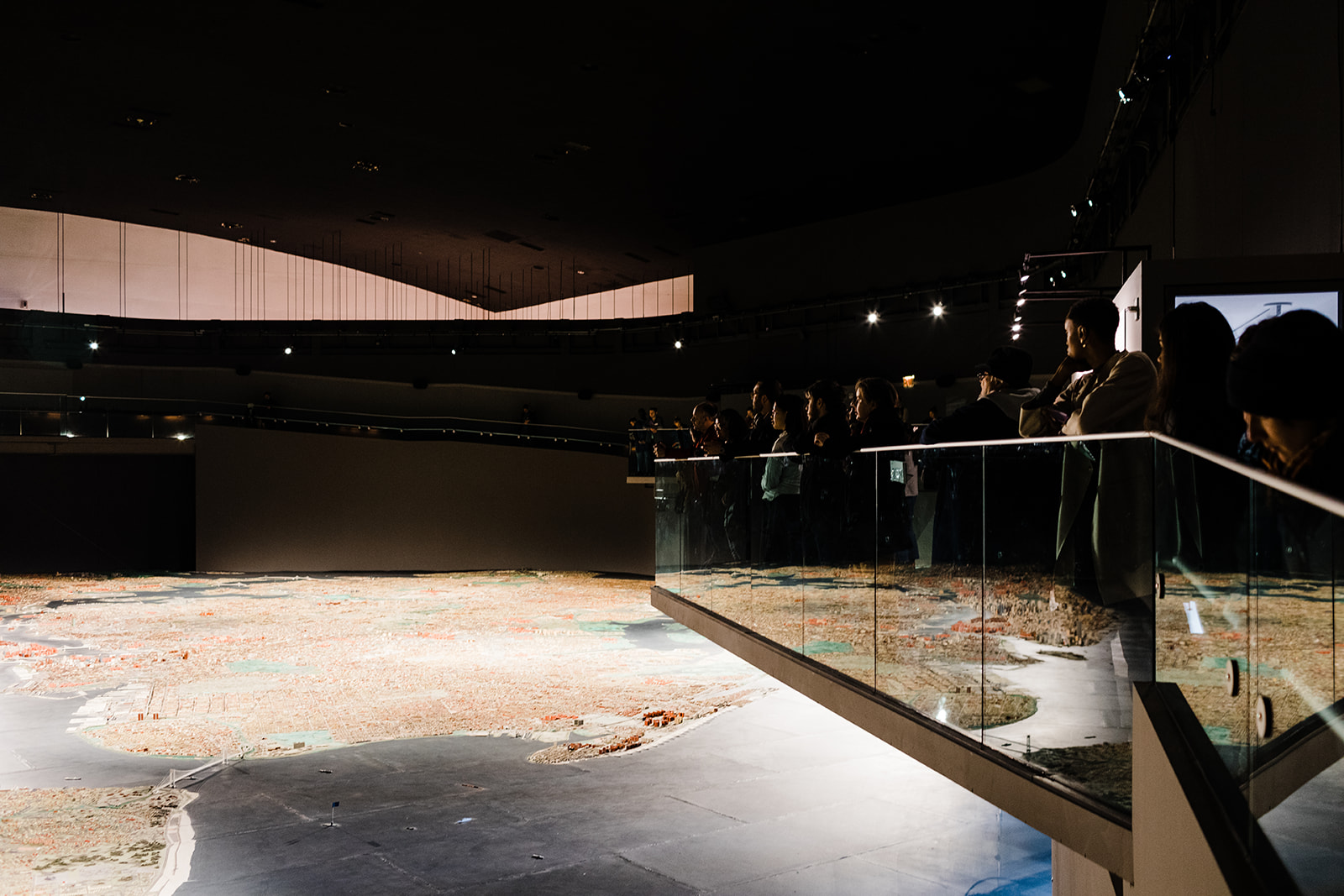
Located at the Queens Museum—home of the Panorama of the City of New York and in the heart of the nation's most diverse borough—“The Green New Deal: A Public Assembly” took place within US Congressional District NY 14, jurisdiction of the GND Resolution’s sponsor Representative Alexandria Ocasio-Cortez, who joined the assembly with a pre-recorded video.
The event was organized by the Queens Museum, the American Institute of Architects New York (AIA New York), The Architecture Lobby, Francisco J. Casablanca (¿Quién Nos Representa?), and Gabriel Hernández Solano (GND Organizer), together with the Temple Hoyne Buell Center for the Study of American Architecture at Columbia University. At the Buell Center, “The Green New Deal: A Public Assembly” forms part of the project “Power: Infrastructure in America,” within which the Center is organizing a series of research, curricular, and programming initiatives to consider the social, technical, and political contours of the ambitious— but still largely undefined—proposal.

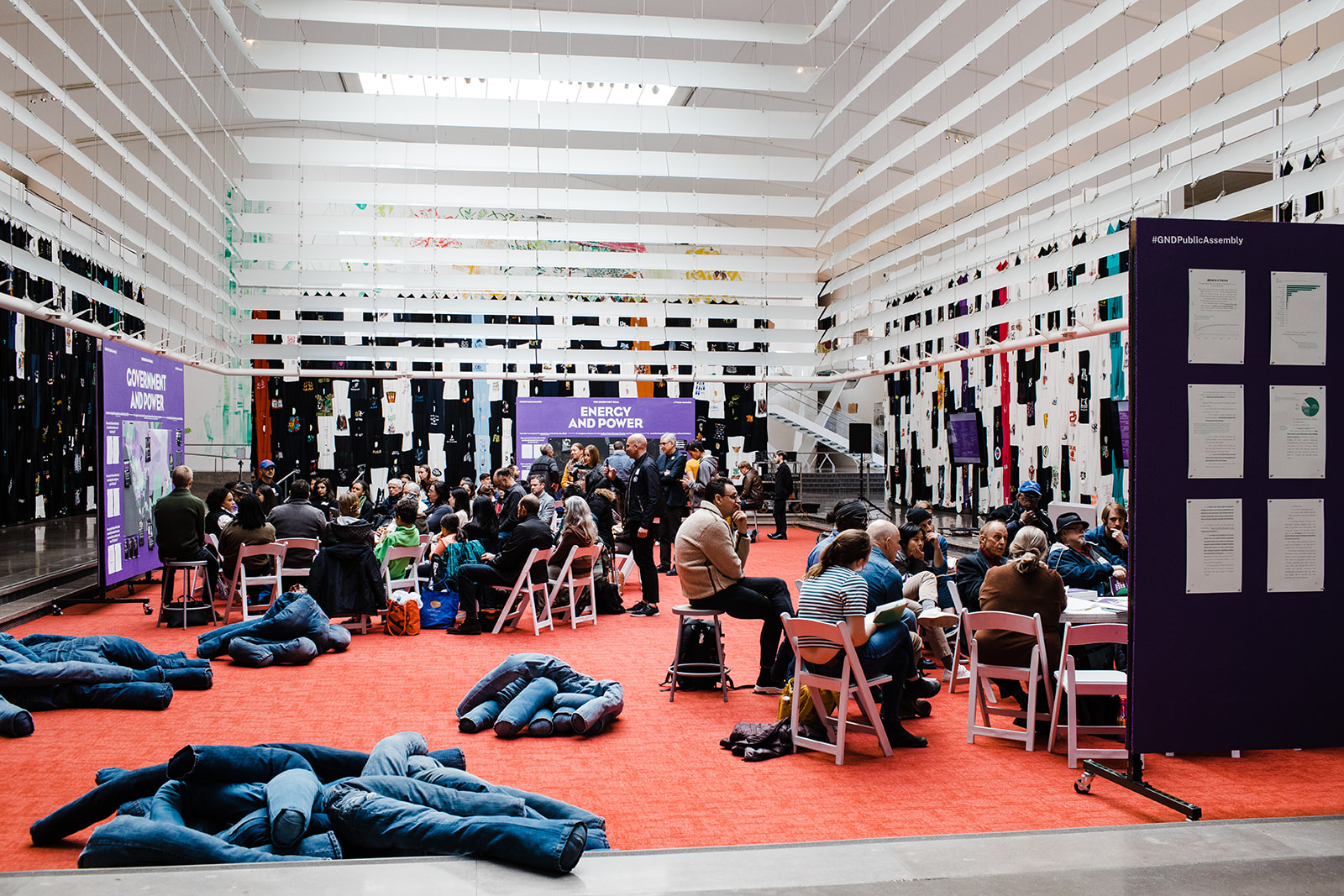
On Friday September 13, 2019, at the University of Pennsylvania, “Designing a Green New Deal” assembled hundreds for a day long conference featuring a polyphony of voices coming from government, academia, activism, as well as professionals from the nonprofit and private sectors.
We are entering a period of once-unfathomable hope on climate change. Grassroots movements and their allies in Congress, led by the insurgent millennial Alexandria Ocasio-Cortez, are staking out an ambitious agenda that matches the scale and urgency of the climate crisis. These new leaders are articulating their vision in terms of a Green New Deal—a still-abstract set of proposals for decarbonizing the economy, eliminating poverty, creating green, working-class jobs, and retrofitting communities for the coming effects of climate change.
Decarbonizing the US economy would be a massive boost to the fundamentally international project of preventing runaway climate change. Domestically, a Green New Deal would constitute a generational investment in planning and design, reshaping the social and physical landscape of the U.S. in ways matched only by the Industrial Revolution, New Deal, and postwar suburban boom. But the debates around fleshing out the Green New Deal vision have been relatively silent on its enormous implications for the built environment. And there is too little dialogue between Green New Deal proponents and the planning and design professions.
Here we sit, in the throes of a new generation’s ecological crisis, buoyed by an ascendant and broad-based progressive movement, as the most ambitious and interesting environmental and design proposal of the last half-century, a Green New Deal, gains momentum. The entirety of the built environment is at stake. And the design professions—for all of their self-important rhetoric about leading on climate—are missing in action.
A national-scale landscape transformation is coming. We'll all have to decide how best to manage and guide that process. Designers must choose if they want to be an active part of the coalition driving this change in the built environment. If they do, they will have to change the way they operate, becoming public servants as they were during the New Deal. They would also gain the chance to bring extraordinary skills to bear on literally rebuilding the country. Creating landscapes of genuine economic and racial equality will require both mass mobilization and the best possible technical expertise.
Designing a Green New Deal intends to bring a broad array of voices together, placing economists, historians, and designers in conversation with journalists, organizers, elected officials, and other parties engaged in organizing for climate action. This event will serve as the launch of a broader, Green New Deal and the built environment research initiative in The McHarg Center and the Socio-Spatial Climate Collaborative (SC2).

The-Architecture-Lobby had originally been planning an in person Think-In to take place in New York City to celebrate the 70th anniversary of Earth Day in April 2020. The global pandemic's stay home order withdrew any such possibility. As a result, T-A-L organized a week long event series, with Earth Day related events hosted by chapters from around the globe.
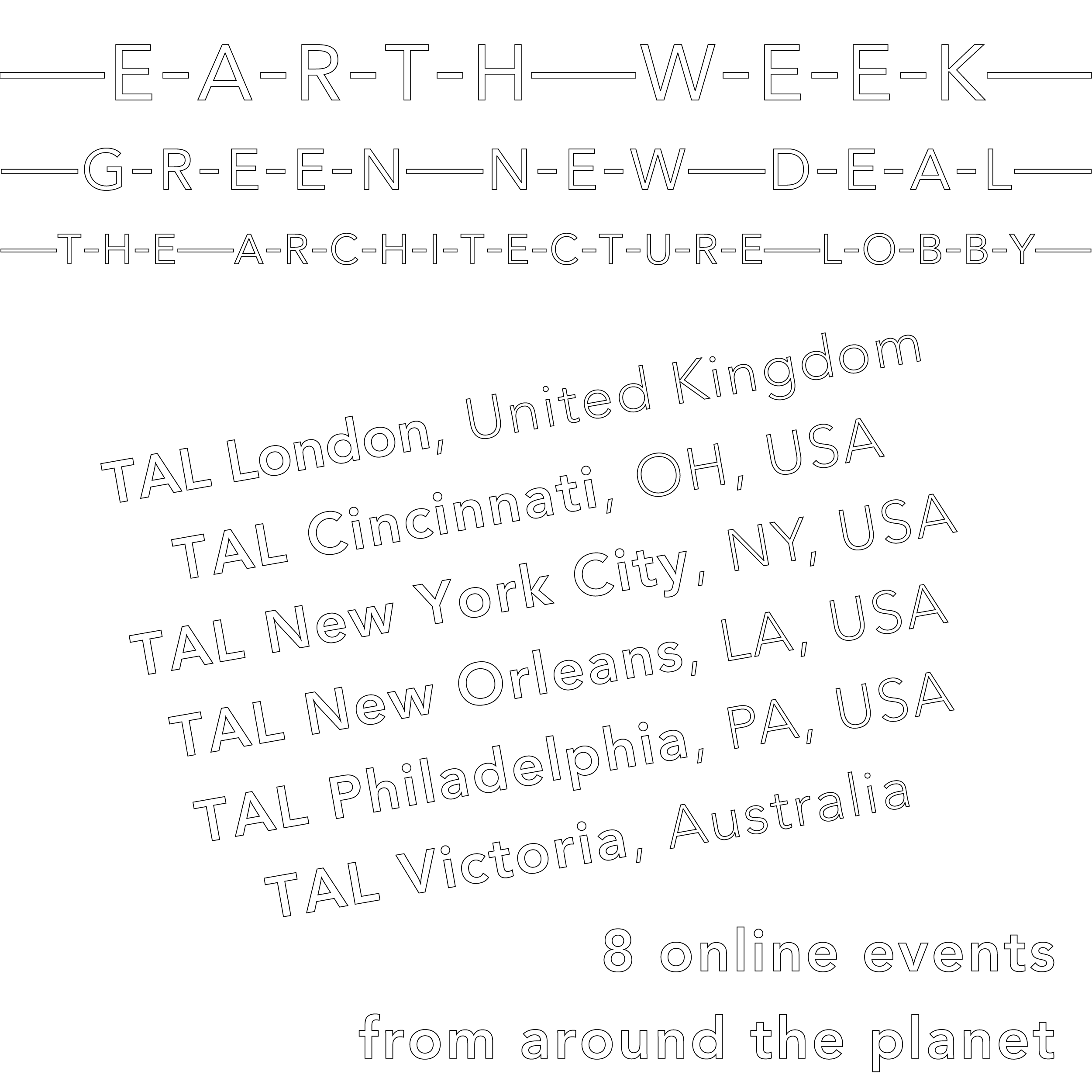
The Architecture Lobby’s Green New Deal Working Group invites you to join us for T-A-L Earth Week, April 20-26!
This year marks the 50th anniversary of Earth Day, which began with teach-ins across the United States on April 22, 1970. In solidarity with the global climate movement, please join us in a series of international events reflecting on the difficult relationship between architectural work and climate change.
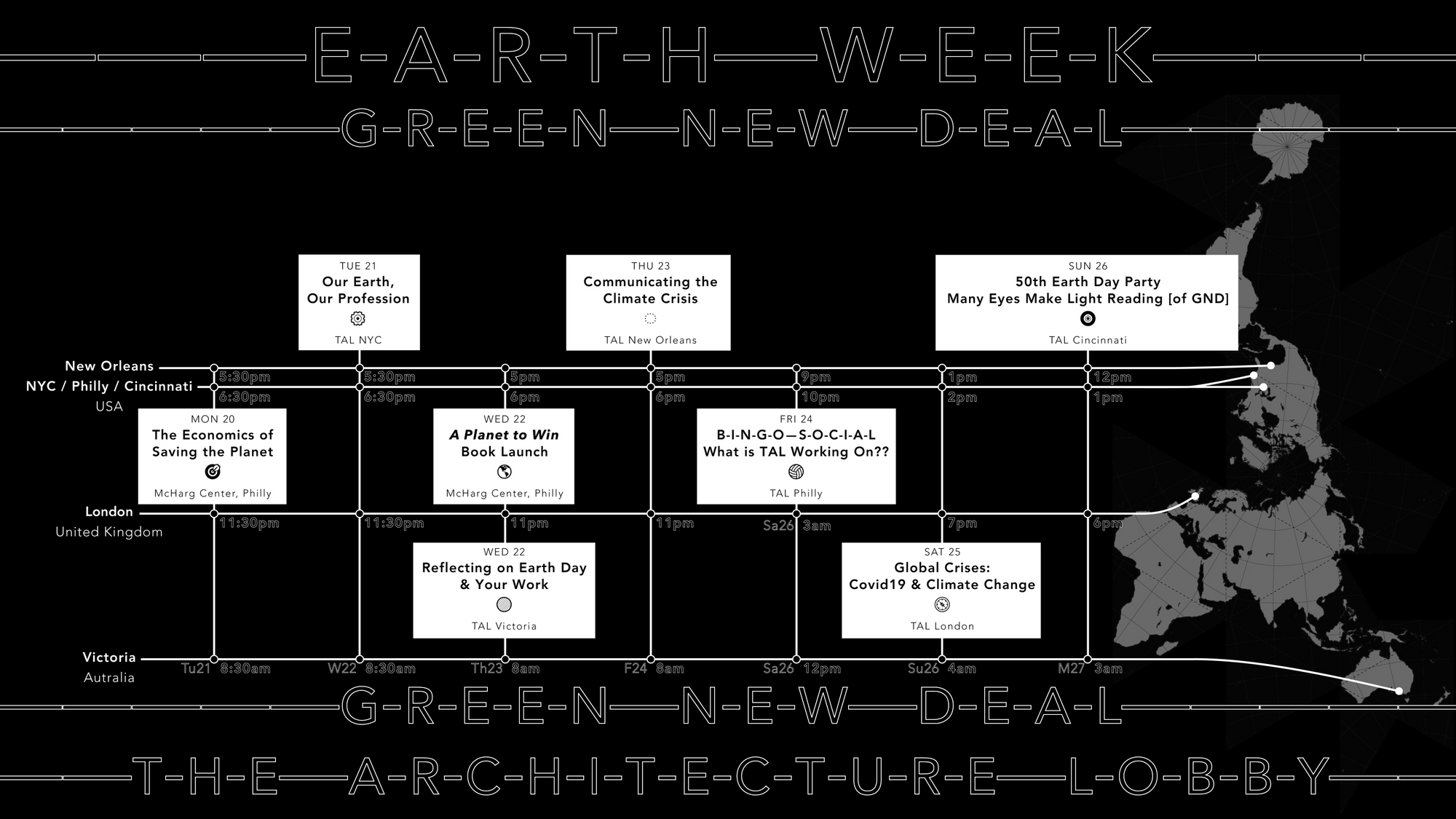
One of the central, unanswered questions for the Green New Deal is: how will we marshal the resources to transform America's economy around its principles of clean energy jobs, justice for frontline communities, and rapid decarbonization? This conversation has begun to take shape in the fields of economics and finance, where green stimulus, industrial policy, and other long-ignored policy levers have once again moved to the center of discourse. On Monday, April 20th, join us for a moderated discussion between Stephanie Kelton, Ann Pettifor, Gernot Wagner, and Arthur van Benthem about the economics of the Green New Deal.
How can architects facilitate and organize for a just transition that supports the reorganization of power needed to confront the crises of climate change and social inequity? This virtual think-in brings together Jacob R. Moore, Damian White, Harriet Harriss, and The Architecture Lobby in a public discussion on architecture’s relationship to climate, frontline communities, the construction industry, labor, and education.
Today is Earth Day. Join The Architecture Lobby’s Victoria Chapter in creating a space to reflect on the Earth and our relationship with it. Are you able to enact your values about the Earth through your work?
Join us for a public discussion with the authors of "A Planet to Win: Why We Need a Green New Deal.” The book explores the political potential and concrete first steps of a Green New Deal. It calls for dismantling the fossil fuel industry, building beautiful landscapes of renewable energy, and guaranteeing climate-friendly work, no-carbon housing, and free public transit. And it shows how a Green New Deal in the United States can strengthen climate justice movements worldwide.
Join us for a presentation by photographer Virginia Hanusik, whose work chronicles the intersection of climate change, architecture, and infrastructure in southern Louisiana. This event will feature a virtual ‘gallery tour’ of Virginia’s work, where she will discuss how she came to photograph the changing landscape of coastlines, and how her work relates to a larger agenda of climate change activism.
Maybe you’ve just discovered TAL and want to see what we’re all about. Maybe you’re in our Green New Deal working group and haven’t been able to check in with the Socializing Small Practices working group. Or maybe you just want to have a drink and see some friendly faces. Join us for B-I-N-G-O S-O-C-I-A-L, hosted by the Philly Chapter. Learn what TAL’s various working groups and chapters have been up to and ease into the weekend with a drink, or two, or three.
The UK based chapter of the Architecture Lobby will host a conversation with organizers from the field of architecture to discuss sustainability, justice and solidarity in the architectural profession. This discussion will bring together Anna Lisa McSweeney (Architects Climate Action Network - ACAN) and Stephanie Edwards (Urban Symbiotics, RIBA London Councillor) in conversation with Elisavet Hasa (T-A-L) to address how the ongoing climate change crisis, especially amidst this pandemic, affects the ways architects are organizing around working conditions and gender equality, and our demands on housing.
The Architecture Lobby - Cincinnati Chapter will be teaming up with Cincy Nice Social House's Mother Earth Days, an 18-day celebration of our planet and our creators, to create an engaging format to understand the policies and plans our lawmakers are considering to combat climate change. Rep. Alexandria Ocasio-Cortez has introduced The Green New Deal as a 10-year effort to mobilize every aspect of American Society to 100% clean and renewable energy by 2030. Reading an entire piece of legislation is a daunting activity so we are going to break it down and ask participants to read as much as they want before they tag the next person to pick up where they left off. By the end of the event, we will have popcorn-style read the entirety of the Green New Deal and be better informed about how we can take on climate change as citizens.

Those events were fruitful, but our group needed a long term strategy. We held an internal workshop through which we documented our thoughts and produced a summarizing diagram that we have come back to over and over throughout the years.

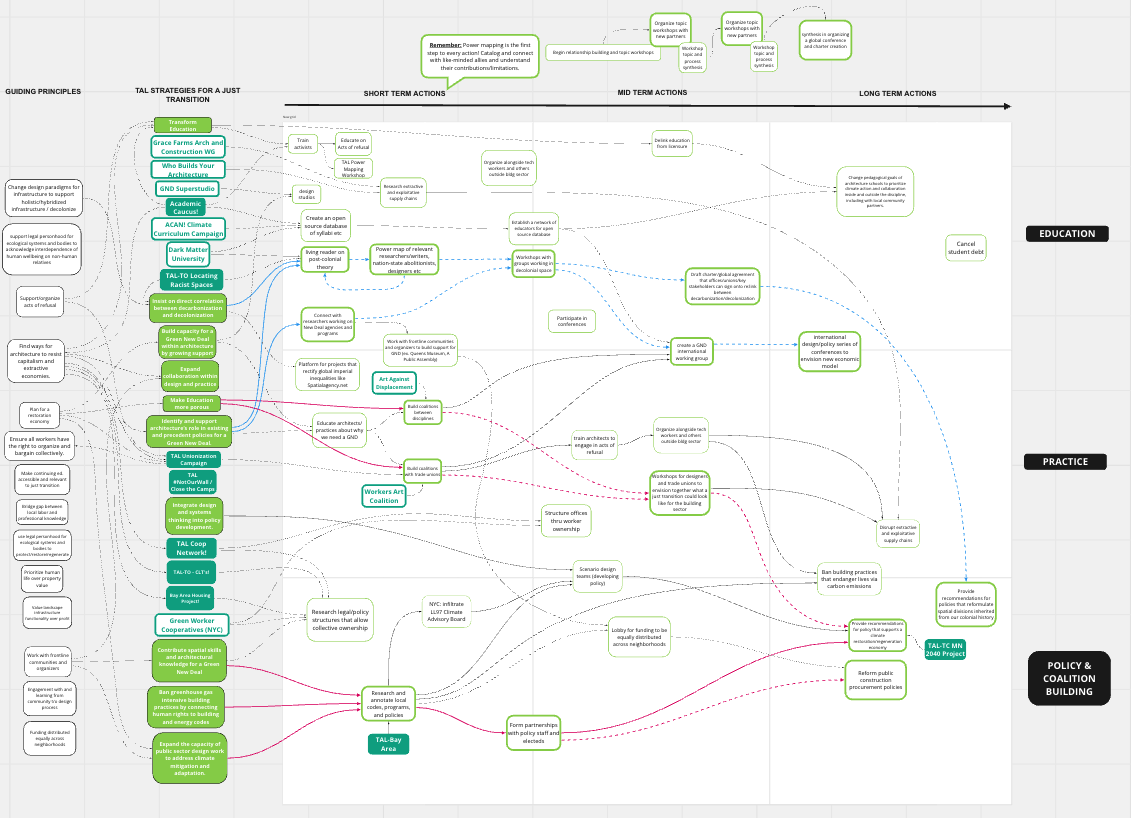
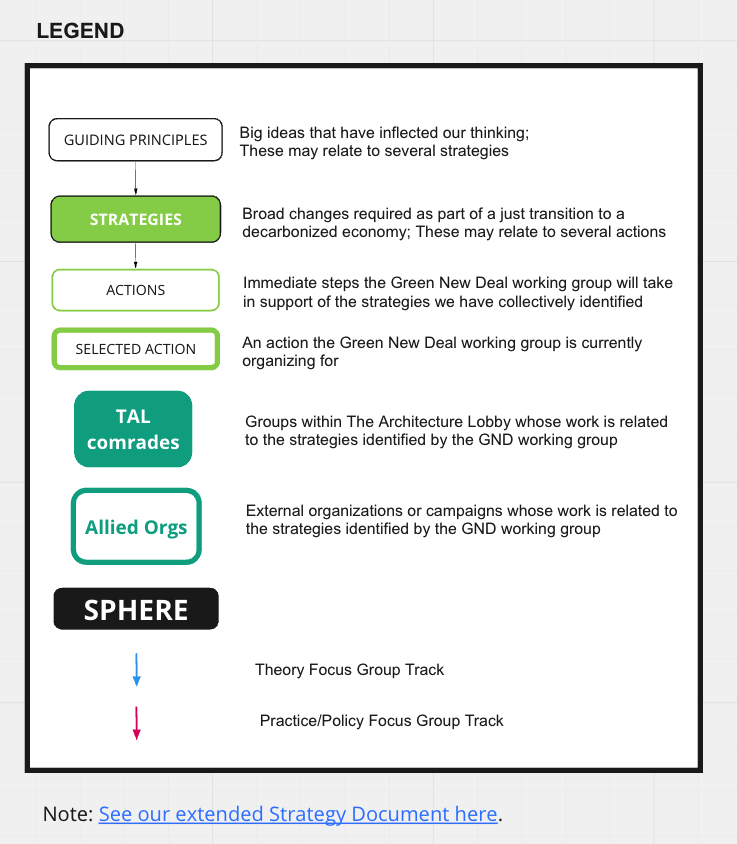
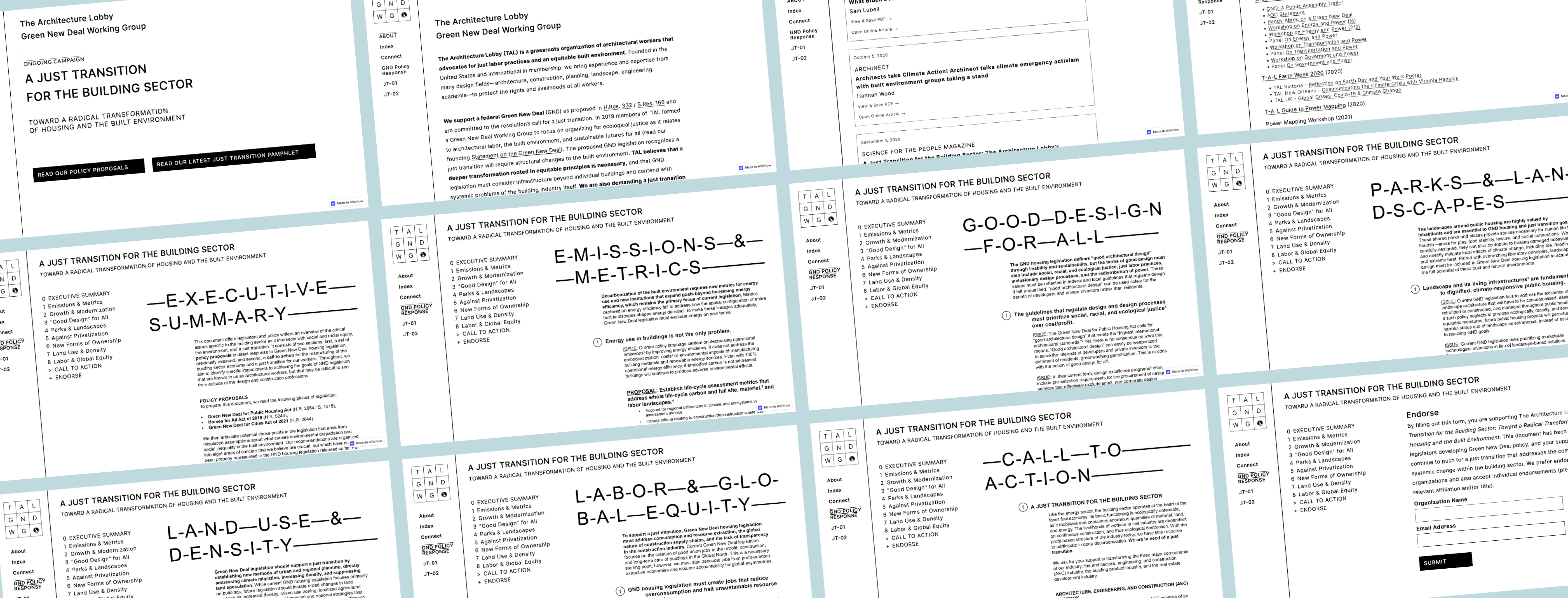
This process allowed us to build internal alignment in realizing that the most important things we could do would be to communicate with legislators. We developed a two part document containing:
In the policy proposals, each of the 8 sections is divided into:


To share our calls to action, we used a power-map to identify key players. It provided a communication strategy which we would materialize through digital communications supported by a website featuring description about our group, our proposals, our various projects, etc.
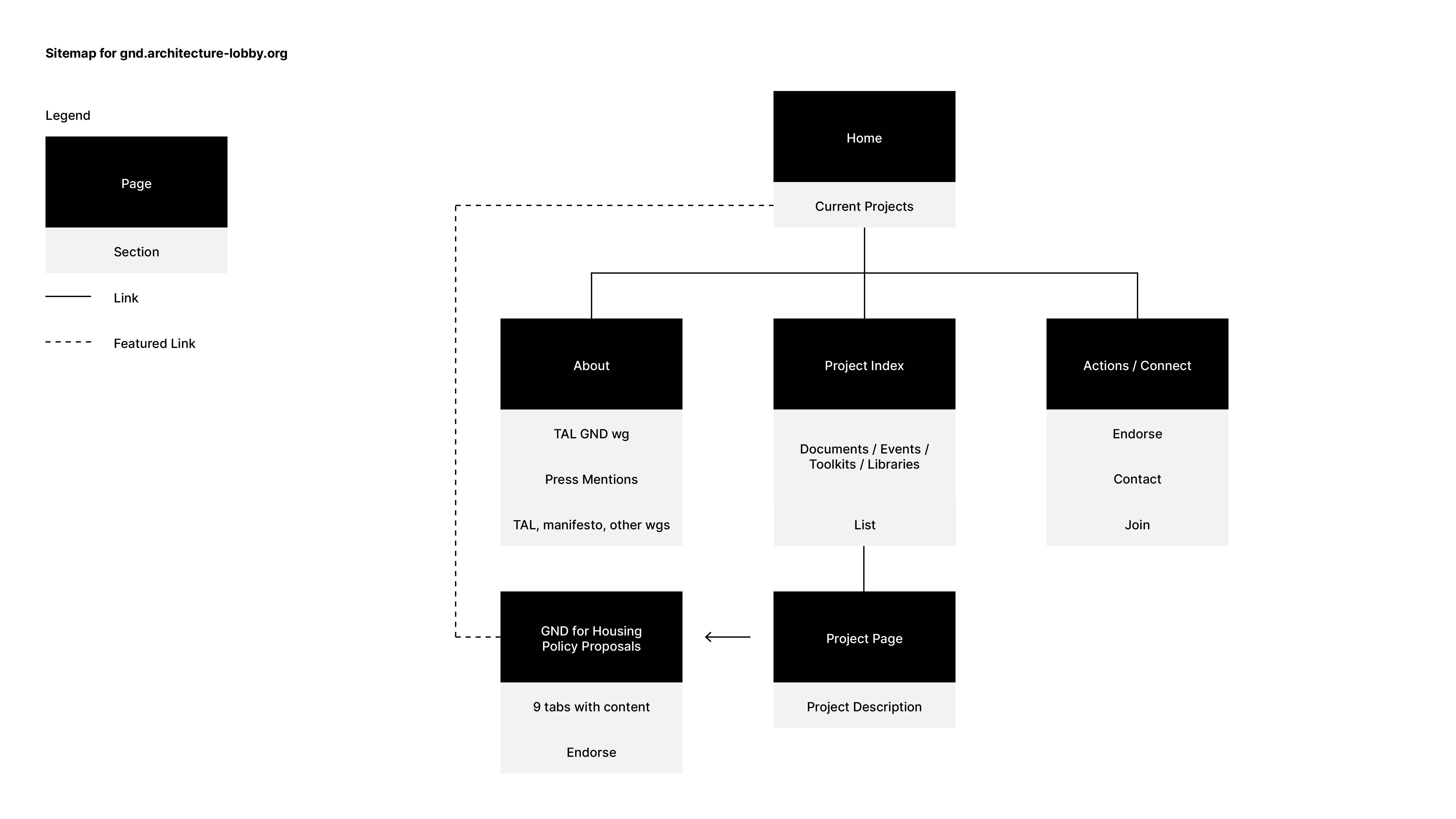
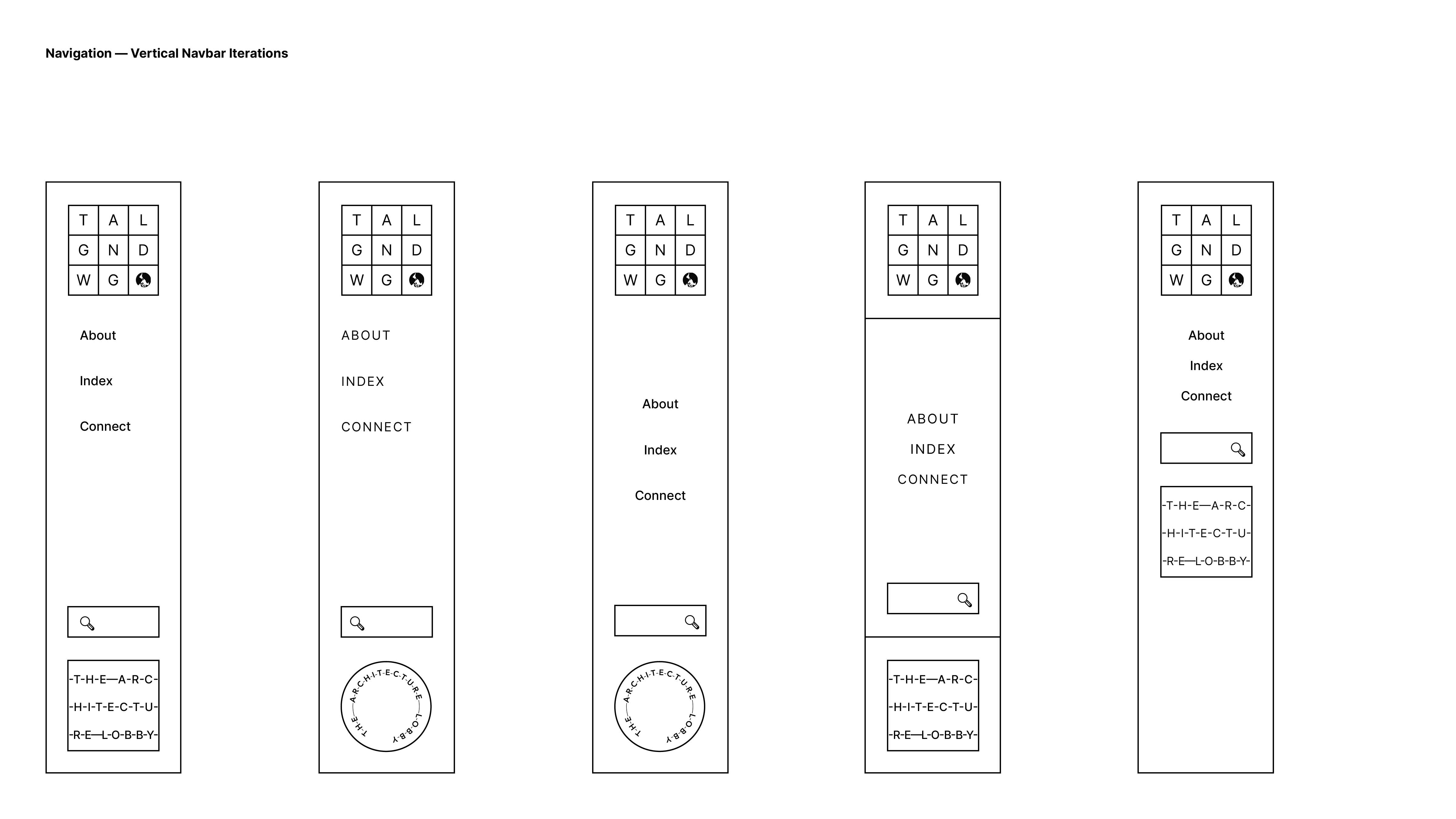


'Le chêne,' pronounced [leuh-sheh-n' means oak tree in French, my native language.