Organizational Design ● Strategy ● Interaction Design
We know through painful experience that freedom is never voluntarily given by the oppressor, it must be demanded by the oppressed. — Martin Luther King, Jr.
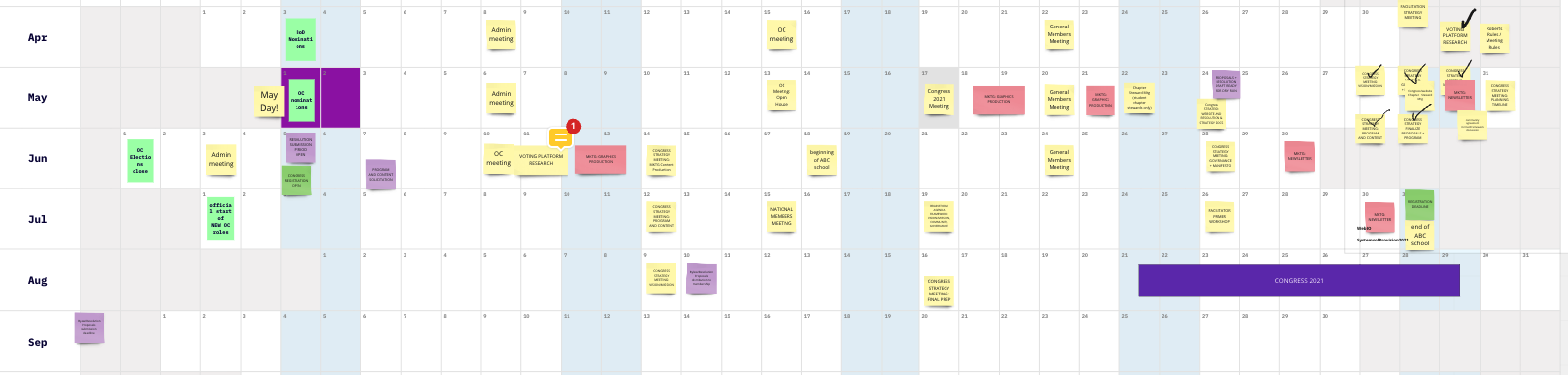
Every two years, members of The Architecture Lobby come together to make collective decisions on the priorities and direction of the entire organization. All members - those in chapters and those who aren’t, those in campaigns and those who aren’t —— come together to debate and vote on how we move forward. We revisit our goals, our strategies and our internal governing structure - to make sure we are on the right path to advancing and achieving our vision.
The planning committee routinely starts their work by reviewing recommendations written by the prior congress planning committee. These insights inform our scope, planning process, and roles. I was designated user experience design lead, responsible to configure an engaging digital interaction.
Holding the congress online posed unprecedented questions:
What topics, questions, and through-lines should drive our programming?
How to make sure the unique decision process is understood ahead of the decision making sessions?
When: dates, times and timezones — how to accommodate our membership's distribution?
A key structure in our organizational framework is the Organizing Committee (OC) meeting which takes place every month over zoom. An all hands meeting of sorts, leading members of the organizations attend this meeting regularly to discuss important topics and vote on pressing matters. In a way, the biennial congress is an extended OC session focused on more fundamental questions.
The congress planning committee used the monthly OC meeting to hold discussions allowing to generate insights allowing us to identify crucial themes to direct meetings: Vision, Governance and Community.
V-I-S-I-O-N
Clarify our organizational mission and state specific goals by proposing our image of a liberated future.
G-O-V-E-R-N-A-N-C-E
How do we carry out our work democratically, so that all members have a voice and an opportunity to participate so that we can accomplish our vision?
C-O-M-M-U-N-I-T-Y
How we work together, what kind of relationships we are fostering, how we treat each other and how we practice solidarity.
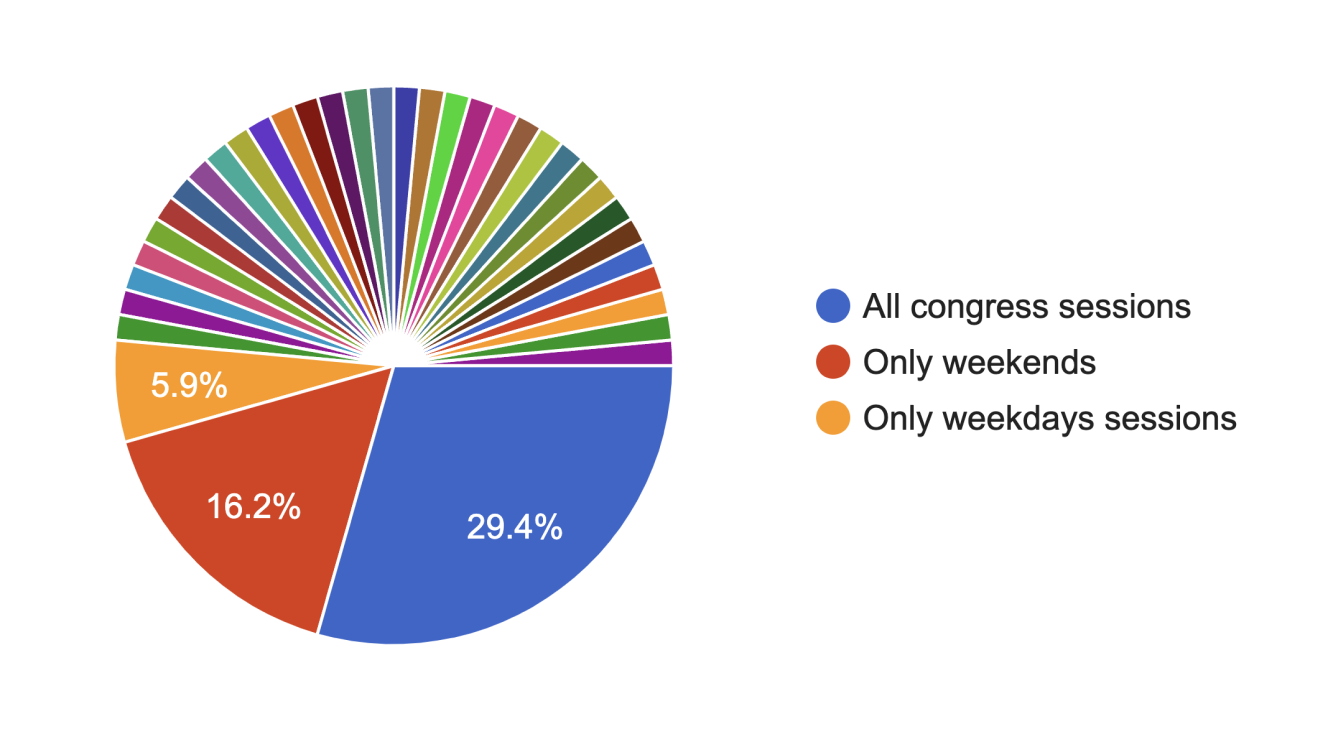
Our first hypothesis is that members are going to have greater availability during the weekend and therefore our important sessions should take place then.
Our second hypothesis is that members are going to be most interested in engaging with the visioning session as it is provides opportunity for big picture, systemic thinking, about how we as a collective see our future.
If this hypothesis is true, the vision sessions could form the basis for conversations held during the governance and voting portion and conversations on the underlying framework of our community.
Projecting our organizational structure two, five, and ten years into the future starts by addressing the day to day topics that are top of mind.
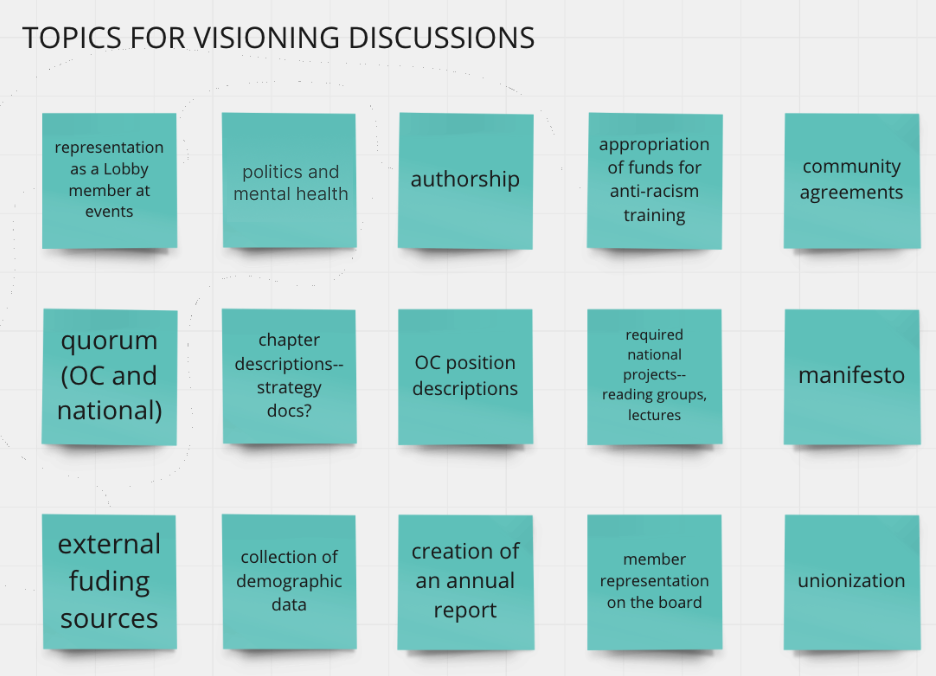
The planning committee carries a workshop sessions during the OC meeting to test interest in this subject. The high engagement confirms that this topic is generative. OC members are prompted to provide vision topics to be discussed through a Miro-board. This input is funneled into a shorter list through affinity mapping.
The themes, hypothesis, and insights gathered through the OC allows us to start drafting a schedule for the congress. Deep discussion and decision making process are to be scheduled during the weekend. The week day sessions are more informative and based on more specific interests.
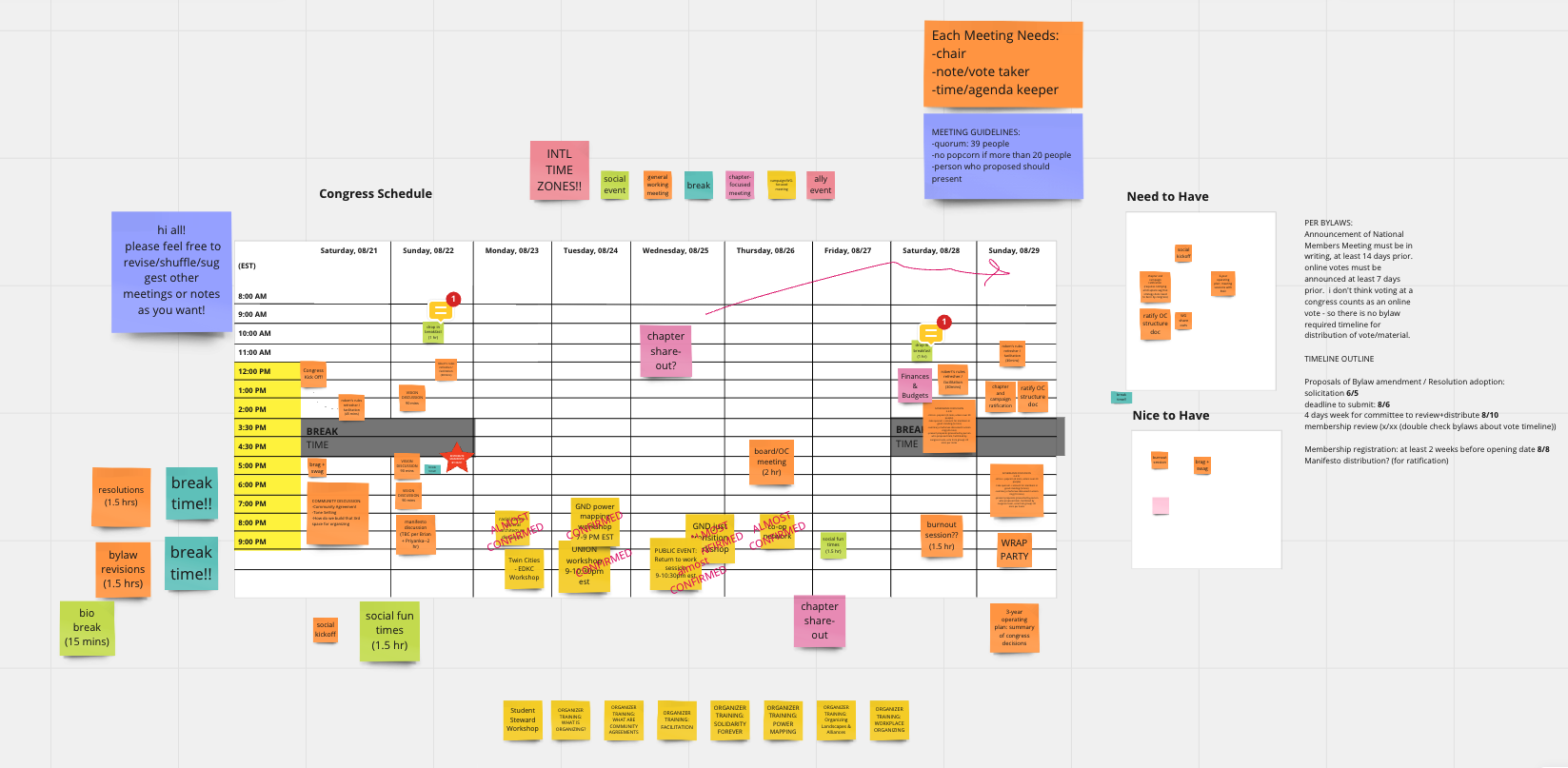
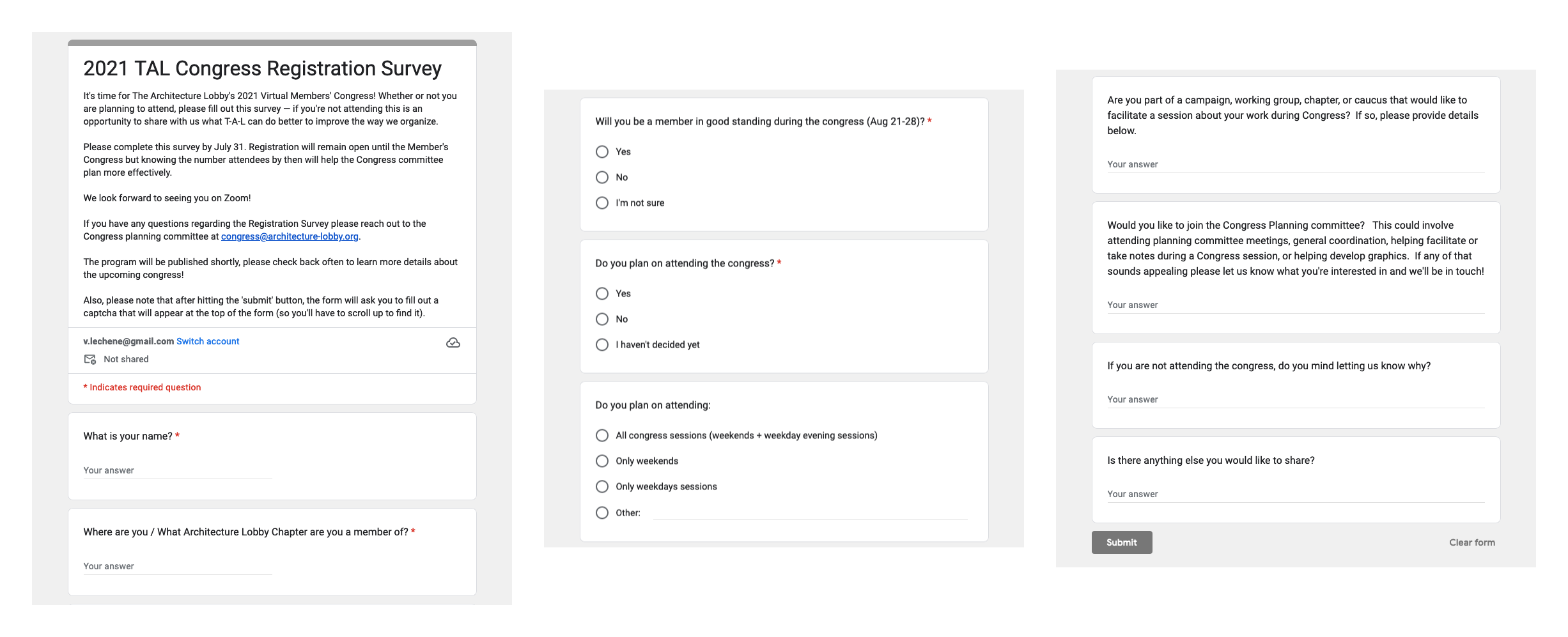
We publish a program and prompt members to register for the Congress. We are seeking to verify the hypothesis made about heightened attendance during weekends.
All times listed for EST.
12:00-1:45pm — T-A-L: Congress Kick-Off!
1:45-2:15pm — Meeting Rules & Facilitation Methods:
Robert's Rules / Consensus
2:15-2:30pm — Break
2:30-3:15pm — T-A-L: MANIFESTO ~Vote~
3:15-4:00pm — Break
4:00-5:30pm — T-A-L: VISION Part 1/3
→ Goal: Discuss and set our shared vision for T-A-L.
5:30-7:00pm — T-A-L: VISION Part 2/3
→ Goal: Revisit mission statement: How does T-A-L work towards and accomplish the vision we set forth? Building upon the conversation in Part 1, we will clarify our organizational mission and discuss strategies for how to get there.
7:00-8:00pm — Break
8:00-9:30 PM — T-A-L: VISION Part 3/3
→ Goal: Workshop a Theory of Change
10:30-11:00am — Drop-In Breakfast: Wage Transparency
12:00-12:30pm — T-A-L: Congress Day 2 Intro
12:30-2:00pm — T-A-L: COMMUNITY Part 1/3
→ Goal: Frame and define our own community of members by setting the democratic principles we commit to as foundations for all our work.
2:00- 2:15pm — Break
2:15-3:30pm — T-A-L: COMMUNITY Part 2/3
3:30-4:30pm — Break
4:30-6:00pm — T-A-L: COMMUNITY Part 3/3
7:30-9:00pm — Academia Working Group: ABC School
7:00-9:00pm — Green New Deal Working Group:
Just Transition for AEC Industry
7:00-9:00pm — T-A-L: Power Mapping Workshop
7:00-8:30pm — CO-OP Network Working Group Share Out
9:00-10:30pm — T-A-L: Organizing the New Normal
6:00-8:00pm — Closed Meeting
8:00-9:30pm — Racial Justice Working Group:
Carceral Architecture Discussion
9:30-11:00pm — T-A-L: Happy Hour
10:30-11:00am — Drop-In Breakfast: Brag & Swag Session
12:00-12:30pm — T-A-L: Congress Day 8 Intro
12:30-2:00pm — Finances & Budgets
2:00-3:30pm — T-A-L: GOVERNANCE ~Vote~ Part 1/4 (Resolutions)
→ Goal: Summarize outcomes of Community/Vision Workshop + Resolution Presentation
4:15-5:15pm — Break
5:15-7:30pm —T-A-L: GOVERNANCE ~Vote~ Part 2/4 (Resolutions)
→ Goal: Resolution Ratifications
10:30-11:00am — Drop-In Breakfast: Burn Out Discussion
12:00-12:30pm — T-A-L: Congress Day 9 Intro
12:30-2:20pm — T-A-L: GOVERNANCE ~Vote~ Part 3/4 (Ratification & Proposals)
2:20-2:35pm — Break
2:35-4:00pm — T-A-L: GOVERNANCE ~Vote~ Part 4/4 (New Proposals)
4:00-5:00pm — T-A-L: Wrap Party

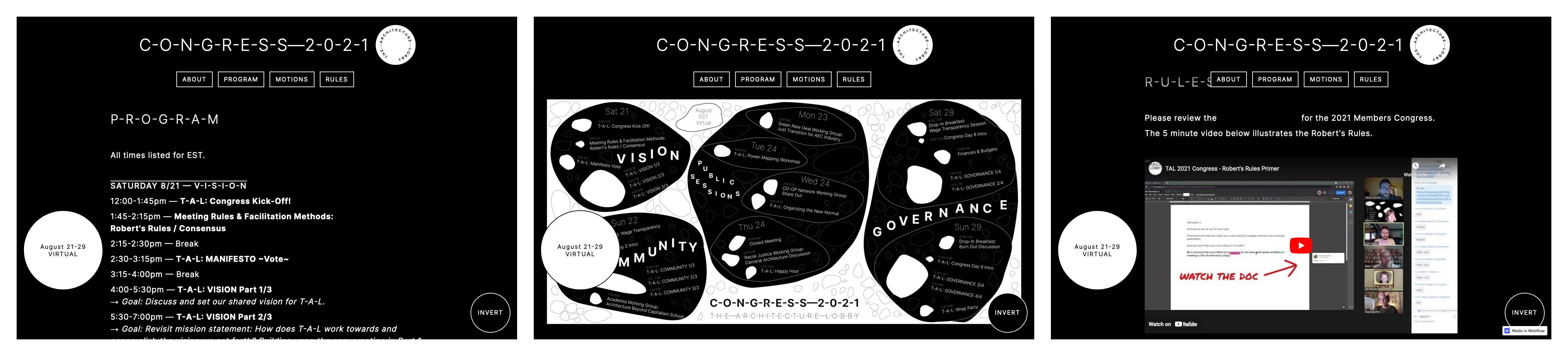
I designed and built a website dispensing important information about the Members Congress. It is a very simple single page.
Keeping in line with the organization's iconic black and white aesthetic, it features the possibility of a inverting dark and light modes.
The governance sessions following the vision session requires two things:
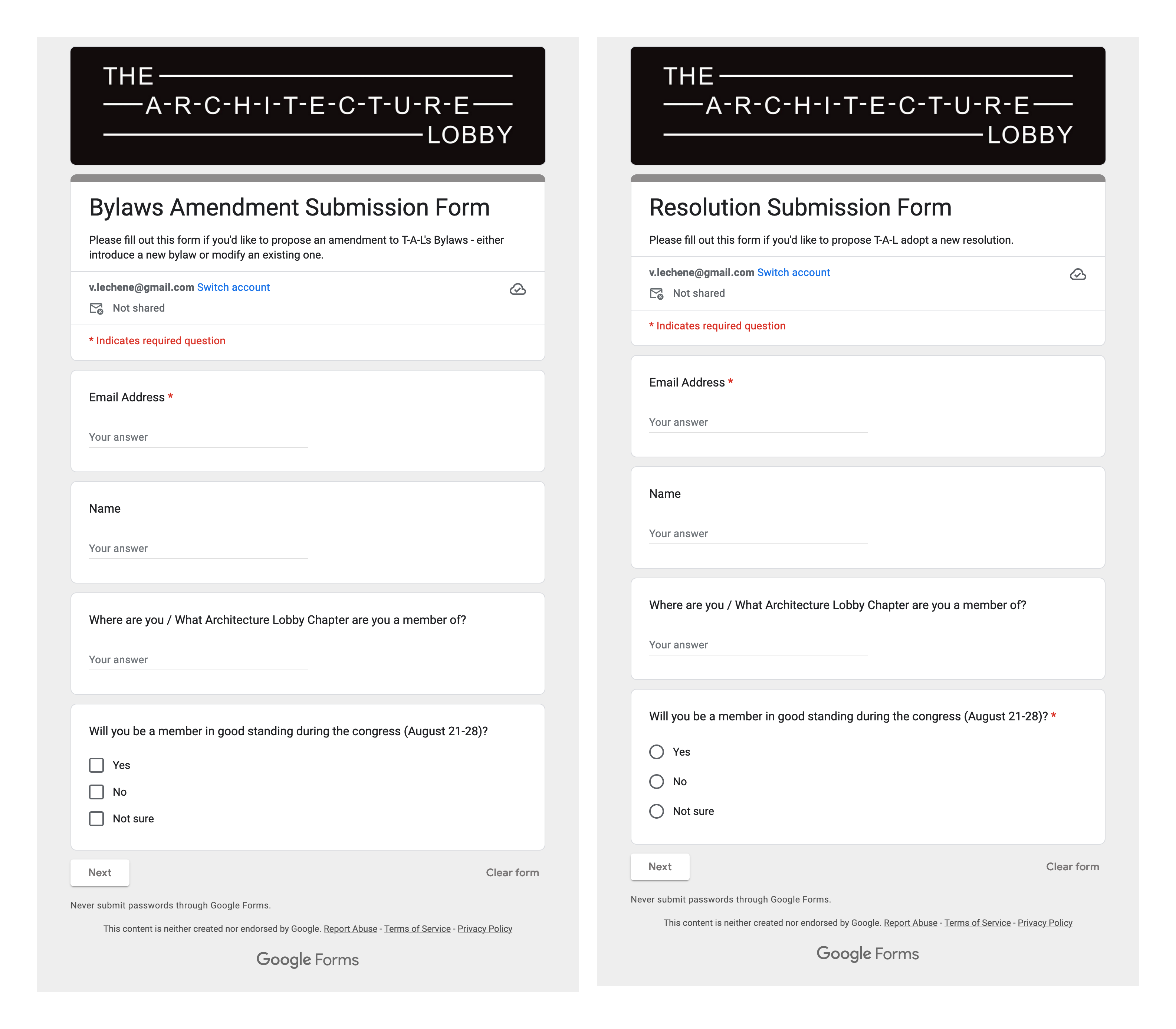
1. Members submit proposal resolutions and by-law amendments ahead of time.
2. Members follow Robert's Rules to vote on the proposed resolutions and amendments.
We decide to communicate about this process by making a five minute scenario video accompanied by a short informational textual document providing summarized key insights.
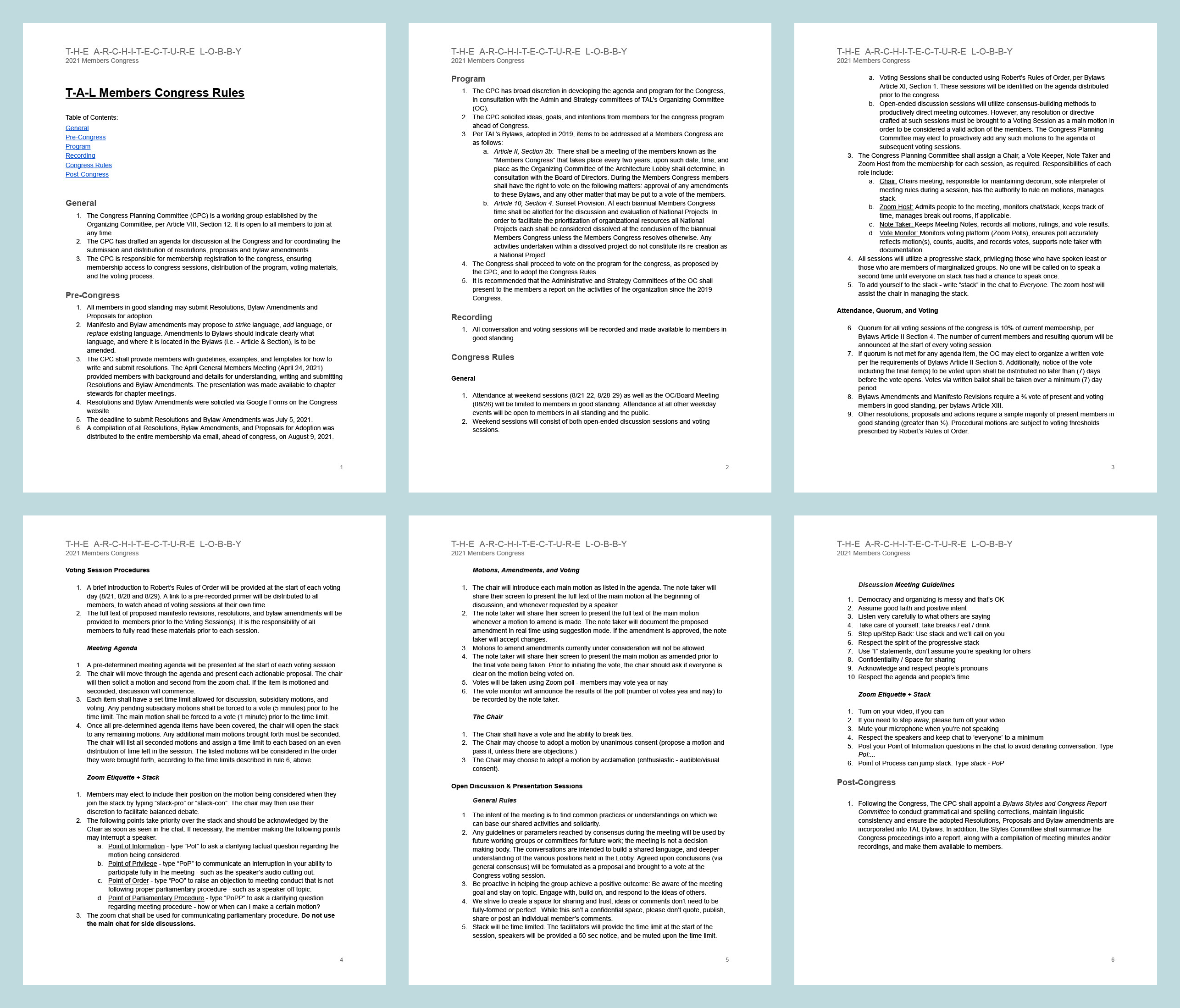
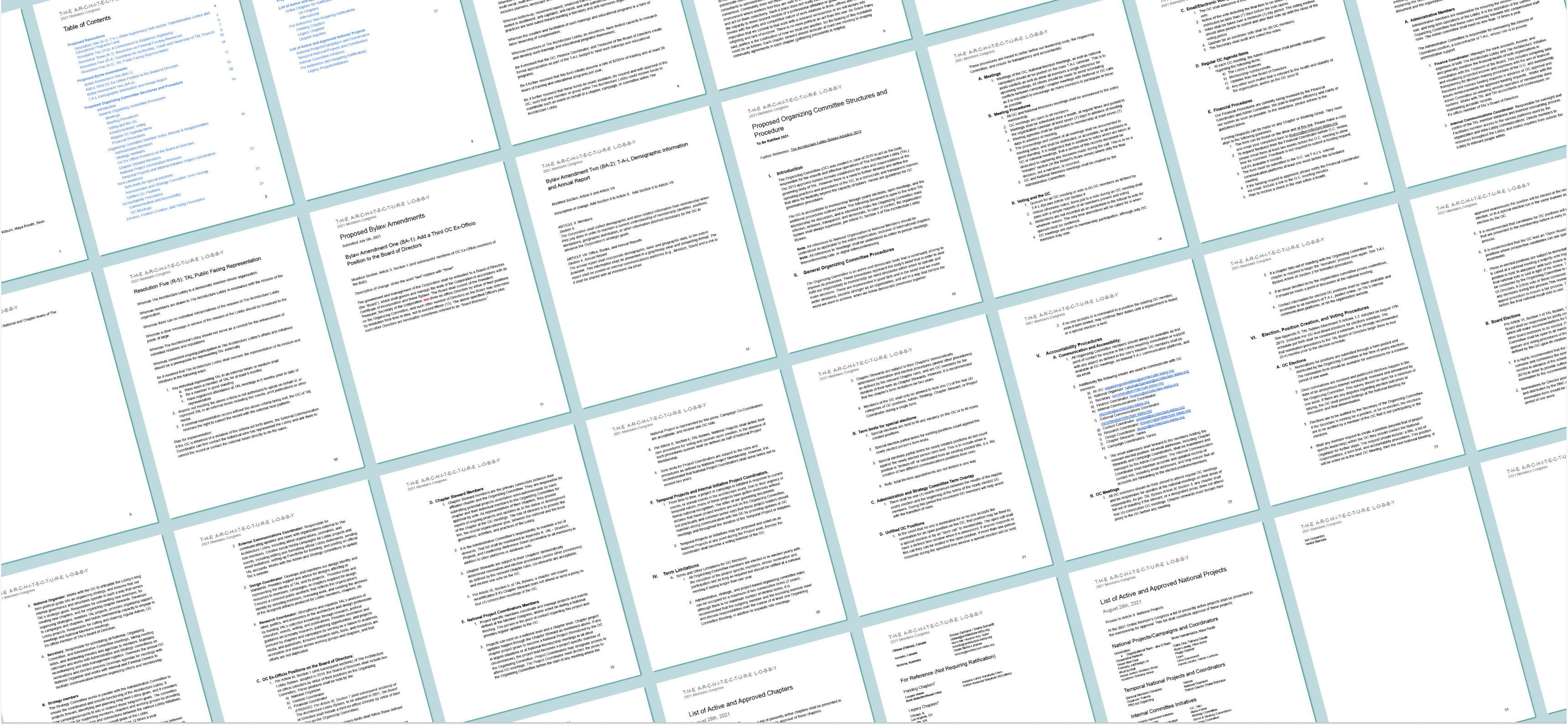
By laws and resolutions are to be submitted via forms. They are then aggregated into a comprehensive and anonymized document shared with the memberships two weeks before congress, providing enough time for careful review.
The mission-vision workshop was one the first event on the congress schedule. Because the congress was being held online instead of in-person, getting it right in terms of engagement was crucial.
We designed a workshop to re-familiarize attendees with the base documents that communicate our mission and vision: our manifesto and boilerplate texts. We juxtaposed with that definitions of mission and vision as well as language about theory of change and an invitation to consider the future of our organization on multiple time-scales (10 years from now, 5 years from now, 2 years from now). These futuring exercises could serve to inform a day to day formulation on our organizational ethos.
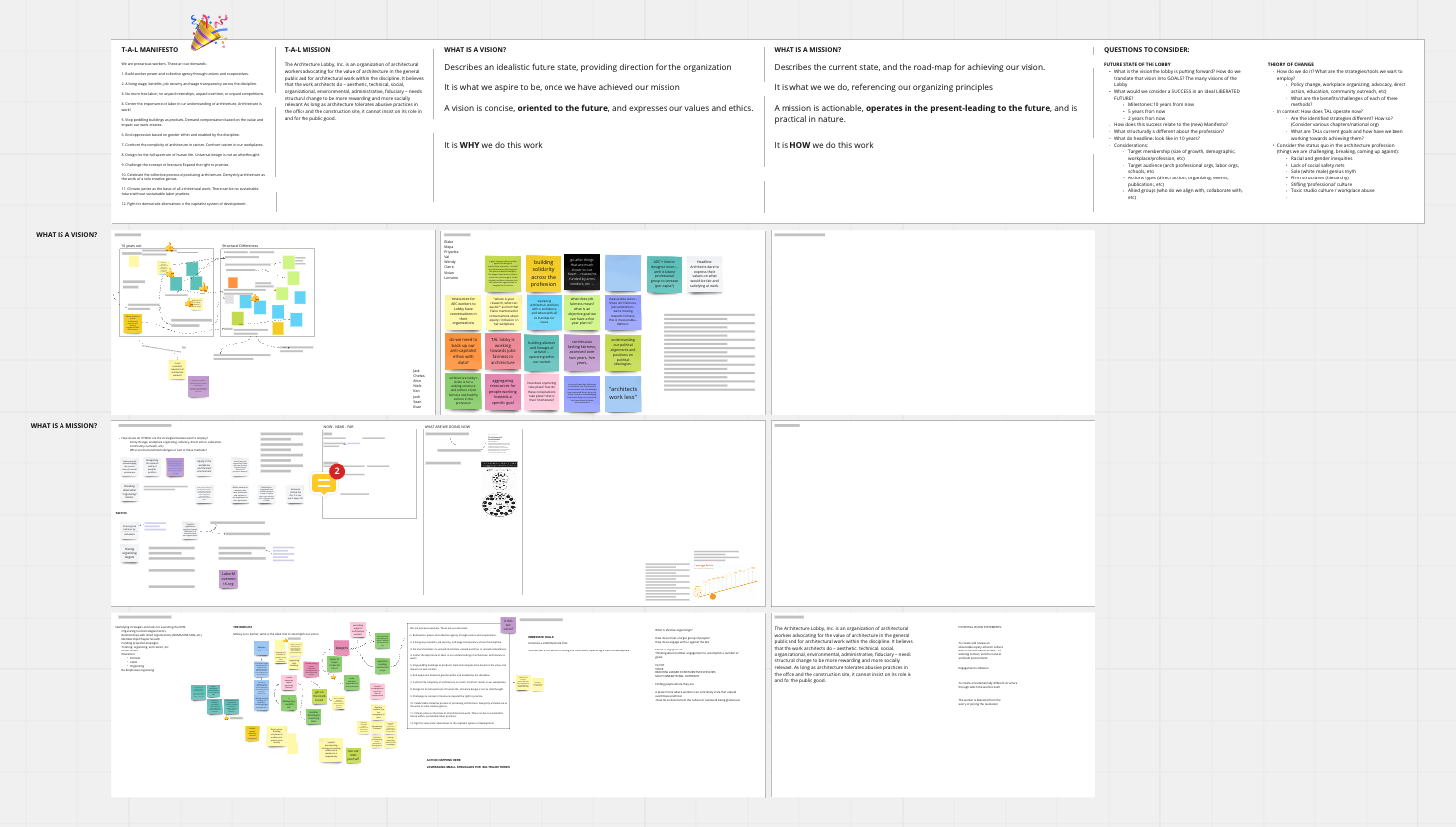
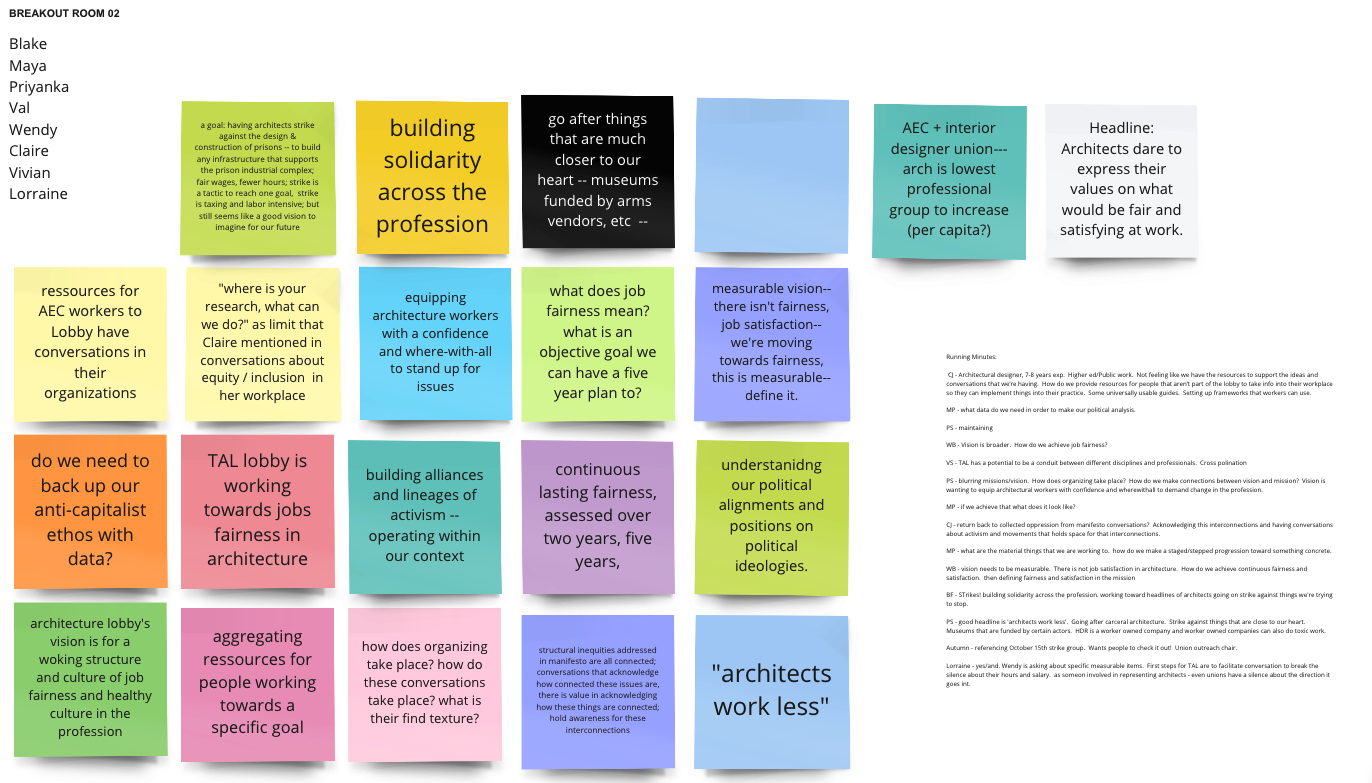
To facilitate conversational engagement, attendees were broken up into breakout rooms of eight people, each with one facilitator in charge of supporting visual documentation in Miro. The outcomes were wonderfully conprehenvie and specific.



'Le chêne,' pronounced [leuh-sheh-n' means oak tree in French, my native language.